
You open Instagram or TikTok in 2026 and it seems like everyone is becoming a millionaire investing from their phone in a week. If you are reading this, you probably already know that’s smoke and mirrors.
The only real way to make money in the stock market is not by guessing which stock will go up tomorrow, but by using the most powerful mathematical force in the universe: compound interest.
In this article, we are going to put empty promises aside and run the real numbers. You will discover exactly how much money you can expect to make, what you need to start, and why your biggest enemy is not the market, but leaving your money in the bank losing value to inflation.
.
📊 The reality of the numbers: The magic 8%
.
To know how much you will make, we don’t need a crystal ball, we look at history. The S&P 500 (the index that groups the 500 largest US companies, like Apple, Microsoft, or Amazon) has yielded a historical average return of between 8% and 10% annually over the last century.
There will be years when it drops 15% and years when it rises 25%. But over the long term, the average prevails.
Let’s see what happens when you apply that 8% to your pocket.
.
💰 Real Examples: The power of starting TODAY
.
Compound interest means your profits generate more profits. Here is the visual demonstration of why time is more important than starting capital.
Example 1: “Coffee” money (€100 a month)
Imagine you invest €100 a month in a global index. That’s 3 euros a day.
• Time:20 years.
• Total money out of your pocket:€24,000.
• Final value of your portfolio:~€59,000. You have made €35,000 literally doing nothing, just by being consistent and letting the market work for you.
Example 2: The consistent saver (€300 a month)
If you take investing seriously and contribute €300 a month at the same 8% average:
• Time:20 years.
• Total money out of your pocket: €72,000.
• Final value of your portfolio: ~€177,000.
Example 3: The “Snowball” effect (30 years)
If you extend the timeframe (ideal for retirement), the curve skyrockets. Investing €200 a month for 30 years means you put in €72,000, but the market returns almost €300,000.
Example 4: I only have €1,000, and I can’t save more, well then…
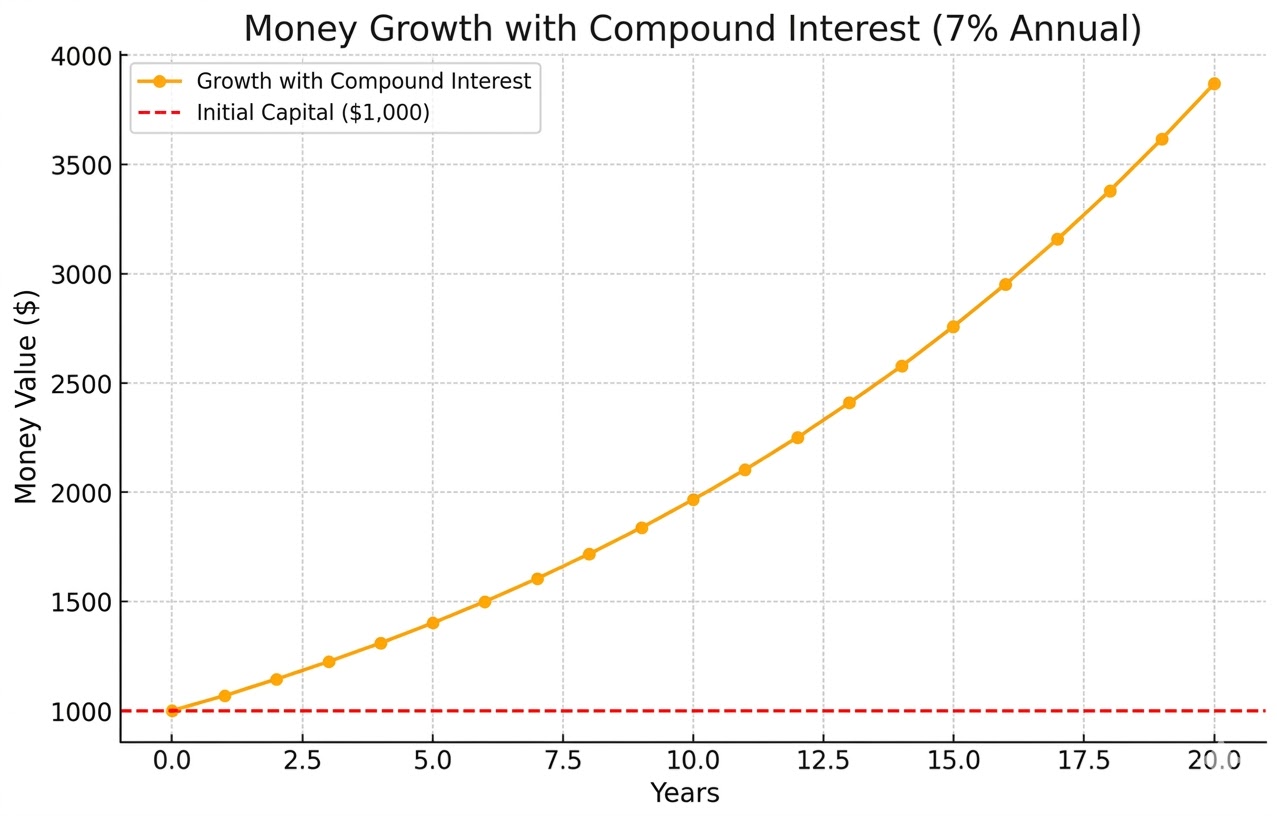
Here is the journey of $1,000 growing at 7% annually; at first, it seems like nothing happens, but look at how the curve becomes ambitious over the years. It’s not black magic or luck, it’s simply compound interest doing the dirty work while you are probably busy with other things. The bad news is that it takes time; the good news is that time passes the same for everyone, you just have to know how to use it. ⏳💰
💡 The lesson: You don’t need to be rich to invest. You need to invest to become rich. The most expensive mistake you can make is thinking “I’ll start when I earn more money”.
.
🚀 How to start investing (and overcome the initial fear)
.
The theory sounds great, but 90% of people never take the step because they don’t know where or how to buy those stocks. They think they need to go to the bank to sign complex papers.
In 2026, all you need is a regulated online broker. And if you are starting, the golden rule is not to complicate your life.
That is why, in the Stock Investing Room community, our main tool is eToro.
Why is eToro the perfect shortcut to start?
1.Zero Commissions on Stocks:You can buy real stocks (not CFDs) at 0% commission. Your money goes straight into the investment.
2.It’s newbie-proof:The platform is as intuitive as using a social network. You won’t see hundreds of incomprehensible flashing charts.
3.The “Copy Trading” feature:If you don’t have time to analyze companies, you can look for professional investors with years of proven returns and hit the “Copy” button. When they buy, you buy. All on autopilot. (You can even copy my public Stock Investing Room portfolio).
The trick to starting with zero risk
The biggest psychological barrier is the fear of losing your money on the first day by hitting the wrong button. eToro solves this by giving you a free Demo account with $100,000 in virtual money.
You don’t have to deposit a single real euro. You open the account, play with the virtual money, see how the market moves, try copying other investors and, only when you feel 100% confident, you make your first real deposit (you can start with as little as €50).
👉 [Open your Free Demo Account on eToro and run your first simulation today] (Affiliate link: Remember that opening the demo account is 100% free and allows you to tinker with the platform without any commitment).
.
❓ Frequently Asked Questions (The doubts we all have at the beginning)
.
What happens if the stock market falls right when I start?
If you are in it for the long haul, market drops should be treated like sales on any product. If you buy €100 every month, and during those months the market falls, with those €100 you get a larger amount of shares for the same price. That is called DCA (Dollar Cost Averaging) and it is a valid strategy, but I particularly prefer its variant VA (Value Averaging), which consists of investing only when the market, or the value of your portfolio drops. For example, I will invest €100 only the months in which the stock market has gone down; in the ones it goes up I buy nothing (obtaining more savings and better prices).
Is it safe to put my money in eToro?
Totally. Your money is not kept by the platform, it is segregated in regulated bank accounts. eToro is supervised by the strictest entities in Europe (CySEC) and registered with the Spanish CNMV.
Remember: The best time was yesterday
The stock market is the most efficient wealth transfer mechanism ever invented, but it only rewards the patient. The difference between reading this article and closing the tab, or opening a demo account and starting to practice, could mean hundreds of thousands of euros of difference in your future.
.
👇 Break the fear barrier, risk-free: [Create your account on eToro (Demo or Real) and start building your wealth]
.
Disclaimer: All types of investment involve risk. Historical data does not guarantee future returns. This article is for purely educational purposes and does not constitute personalized financial advice.